Introduction
Property disputes are among the most common, and most draining, legal battles in India. Whether it's a disagreement over inheritance, a boundary dispute with a neighbour, or a builder failing to deliver on promises, these conflicts can drag on for years if not handled correctly from the start.
Indian law provides multiple structured paths to resolve property disputes, from informal negotiation and online lawyer consultation to mediation and formal civil litigation. Choosing the right remedy, backed by the right documentation, often determines whether a dispute is resolved in months or drags on for years. Understanding how to resolve property disputes legally is the first step toward protecting your ownership rights.
What Is a Property Dispute?
A property dispute is a legal conflict over the ownership, possession, boundary, inheritance, or use of immovable property, typically resolved through negotiation, mediation, or a civil suit filed in the appropriate court.
Property disputes can arise between family members, neighbours, tenants and landlords, buyers and builders, or even between a property owner and government authorities over land acquisition or regularisation.
India's civil courts handle a substantial share of pending litigation as property-related disputes, with inheritance and title disputes among the most common categories, making early legal intervention especially valuable in preventing prolonged litigation.
Common Types of Property Disputes in India
| Dispute Type | Typical Cause |
|---|---|
| Title Disputes | Conflicting claims over legal ownership |
| Boundary Disputes | Disagreements over property lines with neighbours |
| Inheritance/Succession Disputes | Disputes among legal heirs over ancestral or inherited property |
| Partition Disputes | Disagreement over dividing jointly owned property |
| Landlord-Tenant Disputes | Rent, eviction, or possession disagreements |
| Builder-Buyer Disputes | Delayed possession, construction defects, or non-delivery |
| Encroachment Disputes | Unauthorised occupation of another's property |
Legal Remedies to Resolve Property Disputes
Property disputes in India can be resolved through negotiated settlement, mediation or arbitration, or by filing a civil suit for declaration of title, injunction, partition, possession, or specific performance, depending on the nature of the dispute.
| Remedy | When It Applies |
|---|---|
| Suit for Declaration of Title | To legally establish ownership when disputed |
| Suit for Injunction | To prevent illegal interference, sale, or construction |
| Suit for Partition | To divide jointly owned property among co-owners |
| Suit for Possession | To recover possession from an unauthorised occupant |
| Suit for Specific Performance | To enforce a sale agreement the other party refuses to honour |
| Mediation/Arbitration | For faster, less adversarial resolution, especially among family members |
Mediation and Alternative Dispute Resolution (ADR)
Before, or alongside, litigation, many property disputes can be resolved through:
Negotiation, direct discussion between parties, often with legal counsel guiding terms.
Mediation, a neutral third party helps parties reach a mutually acceptable solution.
Arbitration, a binding decision from an appointed arbitrator, often used in builder-buyer or commercial property disputes.
Lok Adalats, informal forums for quicker, cost-effective resolution of certain property matters.
Step-by-Step Process to Resolve a Property Dispute Through Court
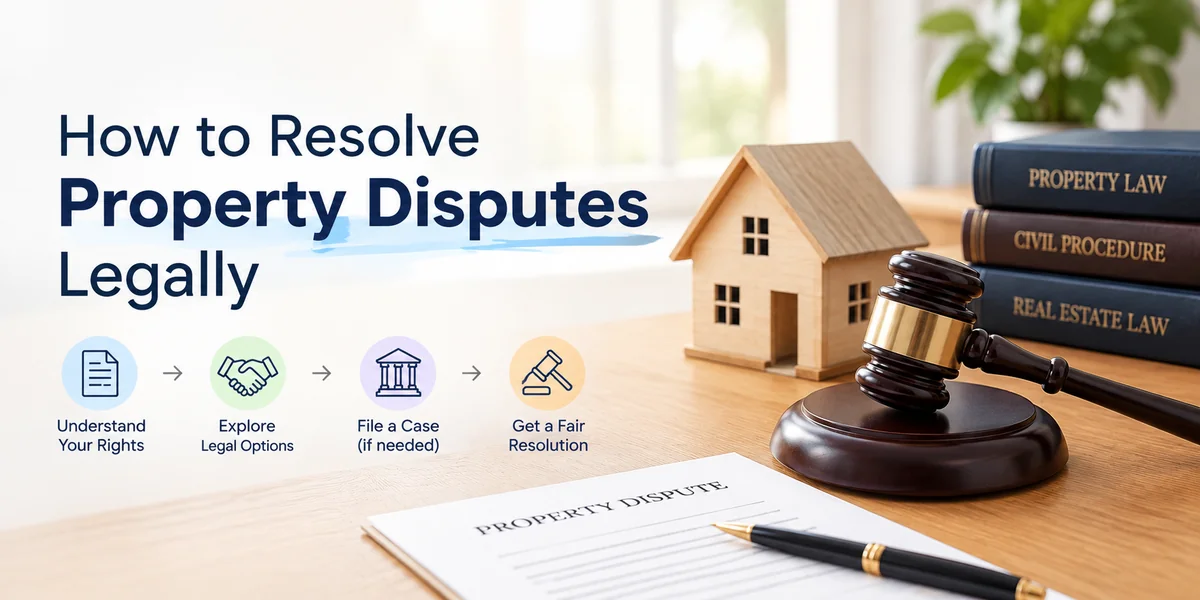
Attempt negotiation or mediation first, where feasible, to save time and cost.
Consult an Expertised property lawyer to assess the strength of your claim and the appropriate remedy.
Gather supporting documents, title deeds, tax receipts, correspondence, and any prior agreements.
File the appropriate civil suit in the court with territorial and pecuniary jurisdiction.
Court issues notice to the opposing party.
Written statement and evidence stage, both parties present their case and documents.
Arguments and judgment, the court passes a final order or decree.
Execution of the decree, if further action (like possession recovery) is required.
Documents Required to Support a Property Dispute Case
Title deed and previous ownership documents
Encumbrance certificate
Property tax receipts
Survey/boundary records (for boundary disputes)
Partition deed or family settlement (for inheritance disputes)
Correspondence, notices, or agreements related to the dispute
Any prior court orders or legal notices exchanged
Common Mistakes That Prolong Property Disputes
Delaying legal action, allowing the dispute to escalate or evidence to weaken.
Not attempting mediation before jumping straight to litigation, especially in family disputes.
Filing in the wrong court due to jurisdictional errors.
Incomplete documentation, weakening the strength of the claim.
Ignoring legal notices, which can result in unfavourable ex-parte orders.
In several reported family property disputes, heirs who attempted mediation before litigation resolved partition disagreements significantly faster than those who went straight to court, often preserving family relationships in the process as well.
When to Seek Lawyer Online Advice
Property disputes often involve high financial stakes and complex documentation, getting the strategy right early matters. Getting Online Attorney Advice can help you:
Assess the strength of your claim and the right legal remedy
Decide between mediation and litigation based on your situation
Draft a strong civil suit backed by proper documentation
Navigate court procedures and jurisdictional requirements
Seeking Lawyer Online Advice at the first sign of a dispute, rather than after positions harden, often leads to faster, less costly resolutions.
Conclusion
Property disputes, while common, don't have to mean years of uncertainty. Indian law offers a structured path, from negotiation and mediation to civil suits for title, injunction, partition, or possession, to resolve conflicts over ownership, boundaries, and inheritance. The key is acting early, gathering the right documentation, and choosing the remedy best suited to your specific dispute. With the right legal guidance, most property disputes can be resolved efficiently and fairly.
Why Choose Vakilsearch
Expert property lawyers experienced in title, boundary, and inheritance disputes
CA support for financial and tax-related documentation
Fast processing of case assessment and filing
Affordable, transparent pricing with no hidden costs
End-to-end compliance, from mediation to litigation and execution
Dedicated support throughout your dispute resolution journey
Get Online Attorney Advice from Vakilsearch's property law experts, understand your options and resolve the matter with confidence.
FAQ
YES. Many property disputes, especially family and boundary disputes, can be resolved through negotiation, mediation, or arbitration without the need for full civil litigation.
YES. Mediation is often faster, less costly, and better at preserving family relationships compared to jumping straight into a formal partition suit in court.
YES. Under RERA and the terms of the sale agreement, buyers can seek compensation or possession enforcement against builders who fail to deliver within the promised timeline.
NO. Boundary disputes can often be resolved through a joint survey, local revenue authority intervention, or mediation before escalating to a formal civil suit.
YES. Property owners can file a suit for possession or injunction against an encroacher, and courts can order removal along with compensation in appropriate cases.
Disclaimer
This article provides general educational information about resolving property disputes in India and is not a substitute for legal advice based on specific facts. Procedures, limitation periods and court requirements vary by state and case, so seek an appropriate legal assessment for your situation.