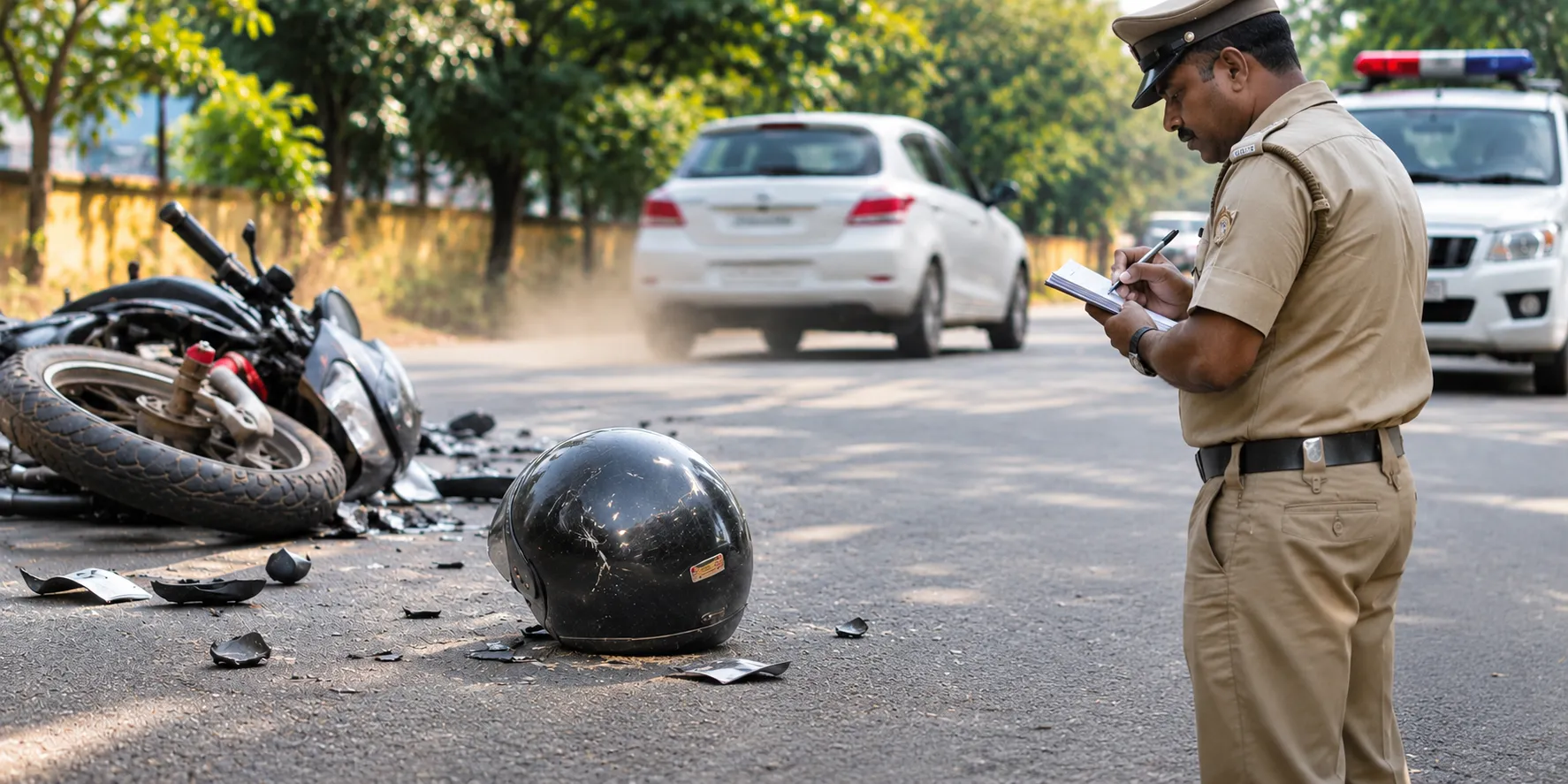
Introduction
Most articles on the "new hit and run law" describe a 10-year prison term for any driver who hits someone and drives away. That is only half the story, and as of the latest reports the stricter part is not in force. Under the Bharatiya Nyaya Sanhita, 2023 (BNS), causing death by rash or negligent driving is punishable with up to 5 years and a fine. The 10-year provision for drivers who escape without reporting to the police is Section 106(2), and it was held back when the BNS came into force on 1 July 2024.
This guide sets out the punishment that applies today, why the 10-year provision was put on hold, what the older Indian Penal Code (IPC) rules still govern, the compensation a victim can claim where the vehicle is unidentified, and the duties that apply to a driver at the scene. It also corrects the common myths that circulate with the phrase "new hit and run law".
Causing death by rash or negligent driving carries up to 5 years' imprisonment and a fine under BNS Section 106(1). The tougher 10-year rule for drivers who flee without reporting, Section 106(2), was held back from 1 July 2024 and had not come into force by July 2026. Victims of unidentified vehicles can claim Rs 2 lakh for death.
What the law says today: the two sub-sections of Section 106 BNS
Section 106 of the BNS replaced IPC Section 304A, which dealt with causing death by a negligent act, and it is divided into two sub-sections. Sub-section (1) covers the ordinary case of death caused by rash or negligent driving. Sub-section (2) was drafted for the aggravated case: the driver causes a death, does not amount to culpable homicide, and escapes without reporting it to a police officer or a magistrate soon after the incident.
| Provision | What it covers | Punishment | Status as of November 2026 |
|---|---|---|---|
| BNS Section 106(1) | Causing death by rash or negligent driving, not amounting to culpable homicide | Imprisonment up to 5 years and a fine | In force since 1 July 2024 |
| BNS Section 106(2) | Same death, plus the driver escapes without reporting to police or a magistrate soon after | Imprisonment up to 10 years and a fine | Held back from 1 July 2024; not implemented in reports up to July 2026 |
| BNS Section 281 | Rash or negligent act in a public way that endangers life, including rash driving | Imprisonment up to 6 months, or fine up to Rs 1,000, or both (an act-level offence, not a death case) | In force since 1 July 2024 |
| IPC Section 304A (and 279, 337, 338) | Death or hurt by rash or negligent act, and rash driving | Equivalent older offences | Still applies to offences committed before 1 July 2024 |
| Motor Vehicles Act, Section 161 | Compensation for victims of hit-and-run accidents where the vehicle cannot be identified | Rs 2 lakh for death; Rs 50,000 for grievous hurt | In force from 1 April 2022 |
Two points follow from the table. First, a driver whose accident happened after 1 July 2024 is charged under the BNS, and the 10-year provision is not one of the charges that can be applied today. Second, an accident before that date is judged under the IPC, because the criminal law in force at the time of the act governs the offence.
The official position can change by notification in the Gazette of India. Before quoting Section 106(2) as in force, or as held back, check the current Gazette notification on the Ministry of Home Affairs or India Code website.
Why the 10-year hit-and-run provision was put on hold
The BNS, along with the Bharatiya Nagarik Suraksha Sanhita (BNSS) and the Bharatiya Sakshya Adhiniyam, was due to come into force on 1 July 2024. In early 2024 truck drivers, bus and taxi unions protested and went on strike against Section 106(2). Their objections were specific: a driver who could not stop at a crowded or unsafe place risked mob violence, fog and poor visibility make a stop difficult, and a 10-year term with a heavy fine was disproportionate even for accidents that were not deliberate.
The Ministry of Home Affairs then notified that the BNS would come into force on 1 July 2024 "except the provision of sub-section (2) of section 106". Reports published in 2026, including a July 2026 account of a Delhi fatality in which the accused were initially booked under Section 106(1) and the rash-driving section, describe the sub-section as still not implemented. The government also said publicly that a driver who reports the accident on time would face a lesser punishment, and that a driver who cannot stop may go to a safe place and call the police.
What counts as "escaping" under the hit-and-run rule
Section 106(2) is not triggered by the act of leaving the scene alone. The offence has two parts that must be read together: the driver leaves the spot, and does not report the accident to a police officer or a magistrate soon after it happened. A driver who leaves to get medical help for the victim, or to reach a place of safety because of a crowd, and then reports the accident promptly, is in a different position from a driver who drives on and reports nothing.
The idea behind the provision is the "golden hour" after a serious injury, when prompt medical care matters most. The statute does not define "soon after" in days. A court judges it on the facts of each case, which is why a prompt, documented report matters under the sections that are in force today.
- Stopping at the scene, giving first aid and calling 112 or the local police is the safest response, and the strongest evidence of good faith.
- If the driver leaves for safety, the report should be made as soon as possible, with the time and place of the accident and the location where the driver stopped.
- Silence after an accident is the worst position in every case: no report, no help to the victim and no evidence of the driver's account.
Punishment under Section 106(1): rash or negligent driving causing death
Section 106(1) is the provision that applies to most fatal road accidents today. It requires proof that the death was caused by the driver's rash or negligent driving, and that the act did not amount to culpable homicide. The question is the same as in the earlier IPC cases: did the driver take the care that a reasonable driver would take in the circumstances, such as speed, visibility, road conditions, signals and the victim's own conduct.
The punishment is imprisonment of up to 5 years and a fine. Courts weigh the facts of each case, including the driver's conduct after the accident and whether the driver co-operated with the investigation. A driver who stops, helps and reports is in a stronger position on sentence than one who does not. A breach of licence or vehicle-document rules is not an element of Section 106(1); it is a separate matter under the Motor Vehicles Act if it is proved.
| Factor | How it affects the case | Where to find the evidence |
|---|---|---|
| Speed and manner of driving | The main test of rashness or negligence | CCTV, witness accounts, vehicle data, skid marks |
| Conduct after the accident | Stopping, giving help and reporting promptly support the driver; leaving without a report weakens the case | Call records, police station report, hospital records |
| Licence and vehicle papers | Not an element of Section 106(1); a breach is a separate offence under the Motor Vehicles Act if proved | Driving licence, registration, fitness and permit records |
| Victim's own conduct | Relevant to whether the driver's negligence caused the death; it does not by itself excuse the driver | Photographs, mechanical report, witness statements |
Victim compensation under Section 161 of the Motor Vehicles Act
Victims are not left to depend only on a criminal conviction. Section 161 of the Motor Vehicles Act, 1988, as amended in 2019, provides compensation where a hit-and-run accident causes death or grievous hurt and the vehicle cannot be identified. Minor injuries are not covered by the scheme. The compensation scheme under this section came into force from 1 April 2022 and replaced the older solatium scheme.
| Injury | Compensation under the scheme | Earlier amount |
|---|---|---|
| Death | Rs 2 lakh | Rs 25,000 |
| Grievous hurt | Rs 50,000 | Rs 12,500 |
The Supreme Court has also directed that victims must be told about this scheme and how to claim it. The claim is processed under the scheme, and a lawyer or the police can confirm the forum for filing. Families should keep the FIR or police report, the medical records and the death certificate, because these are the documents that establish the accident and the injury.
Where the vehicle is identified, the victim's main route is a claim before the Motor Accidents Claims Tribunal against the owner and the insurer. A hit-and-run claim is different: the insurer is not known, so the statutory scheme applies. Whether a victim can use the scheme and also pursue a claim against an identified owner or insurer depends on the facts, and on how any scheme payment is adjusted against a later award. A lawyer should check this before filing.
What a driver must do at the scene: duties under Section 134 of the Motor Vehicles Act
Independently of the criminal law, Section 134 of the Motor Vehicles Act places duties on a driver involved in an accident that causes injury. The driver must take reasonable steps to secure medical attention for the injured person, including taking the victim to the nearest hospital, and must give the information required by the police and co-operate with the investigation. Breach can attract action under the Act, so a driver should not treat leaving the scene as a safe option.
- Stop the vehicle and make it safe. Switch on hazard lights and do not move the vehicle if it is blocking traffic and a person is trapped.
- Call 112 (the national emergency number) or the local ambulance and police. Take the victim to the nearest hospital where that is safe.
- Give your name, address, licence and vehicle details to the police and the victim's family. Keep copies of everything you hand over.
- Report the accident to the police station within the time the law expects. Note the time and place of the report.
- Do not destroy evidence, repair the vehicle before a police inspection, or discuss the facts with witnesses in a way that could be seen as influencing them.
- Give the information the law requires, but make any detailed statement that could incriminate you only after you have taken legal advice, especially if a crowd, threats or an arrest are involved.
What families and victims should do after a hit-and-run accident
If a family member is hurt in a hit-and-run accident, the first priority is medical care, followed by a complete police record. The FIR should describe the accident as a hit-and-run where the vehicle was not identified, so that the Section 161 claim can be processed. Ask for a copy of the FIR, the medical examination record and, if there was a death, the post-mortem report.
- Ask the police for a copy of the FIR and the case number at the time of registration.
- Collect CCTV footage, the names of witnesses and the location of the accident as soon as possible; footage is often overwritten within days.
- Keep every medical bill, receipt, prescription and discharge summary; they are needed for both the criminal case and the compensation claim.
- Check whether the victim or the family has any personal accident or health policy that may pay separately.
- Consult a lawyer about the criminal case, the compensation claim and the timelines that apply to each.
Common myths about the new hit-and-run law
| Myth | What the position is in November 2026 |
|---|---|
| A driver who flees now faces 10 years in prison. | Not under the current law. Section 106(2), which carries 10 years, is held back and was not in force in reports up to July 2026. Causing death by rash or negligent driving carries up to 5 years under Section 106(1). |
| Reporting the accident always protects the driver. | Reporting promptly is the most useful step a driver can take, and the government has said a timely report leads to lesser action. It does not stop a case under Section 106(1) if rash or negligent driving is proved. |
| The IPC no longer applies to any accident. | The IPC continues to govern offences committed before 1 July 2024. |
| Insurance will always pay a hit-and-run victim. | Where the vehicle is unidentified, no insurer is known, so the Section 161 scheme applies instead. |
| Leaving the scene is harmless if the driver is not at fault. | Duties under Section 134 of the Motor Vehicles Act apply regardless of fault, and a driver should report and help. |
Key points to remember
- The punishment for death by rash or negligent driving under BNS 106(1) is up to 5 years and a fine.
- The 10-year rule in BNS 106(2) for escaping without a report was held back from 1 July 2024 and had not come into force in reports up to July 2026.
- Offences before 1 July 2024 are judged under the IPC.
- Victims of unidentified hit-and-run vehicles can claim Rs 2 lakh for death and Rs 50,000 for grievous hurt under Section 161 of the Motor Vehicles Act.
- A driver should stop, help, call 112 and report promptly. Silence and flight are the worst choices in every case.
The law on hit and run is still moving. The safest guide is the Gazette notification in force on the date of the accident, and a criminal lawyer who can read the facts of a particular case. The information above is general and does not replace legal advice for a specific accident or charge.
Frequently asked questions
Not as of the latest reports. The 10-year provision in BNS Section 106(2) was held back when the BNS came into force on 1 July 2024, and reports published in 2026 describe it as still not implemented. The Gazette of India is the authoritative source for any change.
Under BNS Section 106(1), imprisonment of up to 5 years and a fine. Before 1 July 2024 the equivalent offence was IPC Section 304A, which carried a shorter maximum term.
Not under Section 106(2), which is held back. The driver can still be charged under Section 106(1) and face action under the Motor Vehicles Act for failing to stop and help, so fleeing is never a safe route.
It is the most useful step a driver can take. The government has said a driver who reports on time faces lesser action, but a report does not prevent a prosecution under Section 106(1) if rash or negligent driving is proved.
Under Section 161 of the Motor Vehicles Act, as in force from 1 April 2022, Rs 2 lakh for death and Rs 50,000 for grievous hurt, where the vehicle cannot be identified.
The IPC applies to offences committed before 1 July 2024, because the law in force at the time of the act governs the offence. Cases filed later about those accidents continue under the IPC.
Where the other vehicle is identified, the victim claims against the owner and insurer before the Motor Accidents Claims Tribunal. Where it is unidentified, no insurer is known, so the Section 161 scheme applies instead.
Stop the vehicle, call 112 or an ambulance, take the victim to hospital where that is safe, give your details to the police and report promptly. Do not destroy evidence, and speak to a criminal lawyer before giving a detailed statement.
The court decides, after the evidence on speed, road conditions, signals, witness accounts and the driver's conduct is examined. A police report is the starting point, not the final finding.