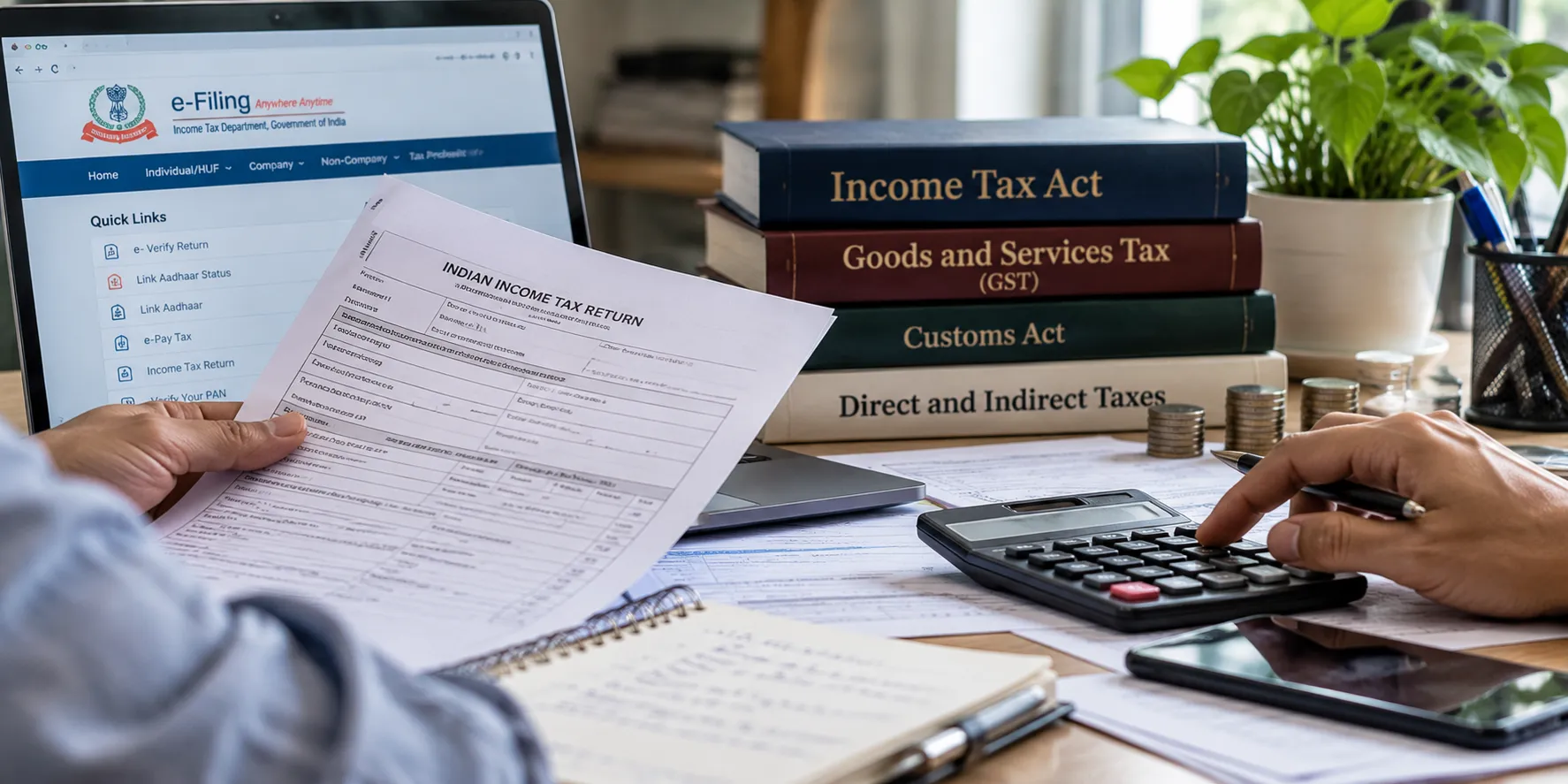
Every salary slip, restaurant bill, property deed and petrol receipt in India carries a tax. Most people pay several taxes a day without noticing, yet few can explain what makes a payment a tax, why the government is allowed to collect it, or why a packet of biscuits and a flat in Mumbai are taxed so differently.
The scale is large. In 2025-26 the Centre collected Rs 23.40 lakh crore in net direct taxes and Rs 22.27 lakh crore in gross GST, 8.67 crore returns of income were filed, and 1.65 crore businesses were registered under GST by May 2026. The system is also changing. The Income-tax Act, 2025 replaced the 1961 Act from 1 April 2026, GST moved to a two-rate structure from 22 September 2025, and the GST compensation cess ended on 1 February 2026.
This guide takes a comprehensive view of the concept of taxation: what tax means and how it differs from a fee or a cess, why governments tax, the constitutional basis of taxation in India, the canons of a good tax, the types of taxes, how direct and indirect taxes work today, how the system is administered, and the debates that surround it.
Taxation is the compulsory collection of money by a government, under a law, to fund public services, with no direct benefit to the payer. In India, Article 265 of the Constitution allows a tax only by authority of law. Taxes are direct, such as income tax, or indirect, such as GST, levied by the Centre, states and local bodies.
What is tax? Meaning and features
A tax is a compulsory payment made to the government under a law, for which the payer receives no direct or specific benefit in return. The money goes into the government's general funds and pays for defence, courts, roads, schools, hospitals, subsidies, salaries and interest on public debt. Taxation is the whole process of designing, levying, collecting and enforcing taxes.
Five features separate a tax from other payments to the government:
- It is compulsory. Refusing to pay is an offence; the choice is not the payer's.
- It needs a law. No authority in India can collect a tax on its own decision, only under an Act passed by Parliament or a state legislature.
- There is no direct return. A taxpayer cannot demand a specific service in exchange for the tax paid. The benefit is collective.
- It is paid in money, on a defined base such as income, profit, consumption, property or a transaction.
- It serves a public purpose. Revenue cannot be raised by taxation for private benefit.
Tax, fee, cess, surcharge and duty: what is the difference?
| Term | What it is | Example |
|---|---|---|
| Tax | Compulsory payment with no direct return; goes to the general funds | Income tax, GST |
| Fee | Payment for a specific service the government provides, broadly linked to its cost. The Supreme Court drew this line in the Shirur Mutt case (1954) | Passport fee, court fee, licence fee |
| Cess | A tax collected for a stated purpose, charged on top of the basic tax. The Centre keeps it; it is not shared with states | Health and Education Cess of 4% on income tax |
| Surcharge | A tax on the tax itself, usually on higher incomes. Also not shared with states | Surcharge of 10% to 25% on income tax above Rs 50 lakh |
| Duty | A tax on goods or documents, named by tradition | Customs duty, excise duty, stamp duty |
| Penalty or fine | Punishment for breaking a law. It raises money but is not a tax | Late filing fee, penalty for under-reporting income |
Why do governments tax? Objectives of taxation
Raising revenue is the first reason but not the only one. Modern tax systems, including India's, pursue several objectives at once:
- Revenue: the Union Budget for 2026-27 estimates the Centre's net tax revenue at Rs 28.66 lakh crore, the largest source of money for public spending. States raise their own taxes and also receive 41% of the Centre's shareable taxes.
- Redistribution: progressive income tax takes a larger share from higher incomes, and no income tax is payable on income up to Rs 12 lakh under the new regime, so the burden falls mainly on those who can bear it.
- Changing behaviour: a 40% GST rate plus additional excise duty on tobacco discourages consumption, while a nil GST rate on individual life and health insurance since September 2025 encourages it. Tax incentives for pension savings or renewable energy work the same way.
- Economic stability: governments cut or raise taxes to support growth or cool demand, and use tax revenue to keep the fiscal deficit (4.3% of GDP targeted for 2026-27) in check.
- Protecting domestic industry: customs duties make imports costlier than local products.
- Accountability: people who pay taxes expect services and question how the money is spent, which is why taxation and representative government grew together.
The constitutional basis of taxation in India
The starting point is Article 265 of the Constitution: "No tax shall be levied or collected except by authority of law." Every tax must trace back to a statute, and the statute must fall within the powers given to that level of government.
Those powers are divided by Article 246 and the Seventh Schedule. The Union List and the State List each contain specific taxing entries, and the Concurrent List has no entry for levying a tax, so until 2017 no tax could be levied by both the Centre and the states. GST changed this: the 101st Constitutional Amendment Act, 2016 inserted Article 246A, which gives both Parliament and state legislatures the power to tax the supply of goods and services, and Article 279A, which created the GST Council.
| Level | Constitutional source | Main taxes |
|---|---|---|
| Union (Centre) | Union List: entry 82 (income other than agricultural income), 83 (customs), 84 (excise on petroleum products and tobacco), 85 (corporation tax); Article 246A (CGST); Article 269A (IGST) | Income tax, corporation tax, customs duty, central excise, CGST, IGST, securities transaction tax |
| States | State List: entry 46 (agricultural income), 49 (land and buildings), 51 (excise on alcohol), 54 (sales tax on petroleum products and alcohol), 57 (vehicles), 60 (professions, capped at Rs 2,500 a year by Article 276), 63 (stamp duty); Article 246A (SGST) | SGST, state excise on liquor, VAT on petrol, diesel and liquor, stamp duty and registration fees, motor vehicles tax, professional tax, land revenue, electricity duty |
| Local bodies | Articles 243H and 243X allow states to authorise panchayats and municipalities to levy taxes | Property tax, advertisement tax, and various local cesses and user charges |
Two other provisions shape how tax money is shared. Under Article 270, most central taxes form a divisible pool shared with states, and under Article 280 a Finance Commission is set up every five years to recommend the split. The 16th Finance Commission, chaired by Arvind Panagariya, recommended that states receive 41% of the divisible pool for 2026 to 2031, which the Centre accepted in Budget 2026-27. Cesses and surcharges stay outside the pool, which is why states object when the Centre relies on them.
Principles of taxation: the canons of a good tax
In The Wealth of Nations (1776), Adam Smith set out four canons of taxation that still frame how tax systems are judged:
| Canon | What it means | How it shows up in India |
|---|---|---|
| Equity | People should pay according to their ability. Those with equal capacity pay equal tax (horizontal equity); those with more pay more (vertical equity) | Income tax slabs rising from 5% to 30%; surcharge on incomes above Rs 50 lakh; nil GST on many essentials |
| Certainty | The amount, time and manner of payment should be clear in advance, not left to officials' discretion | Rates fixed by annual Finance Acts; advance tax due on fixed dates; GST rates notified by the Council |
| Convenience | Tax should be collected at the time and in the way most convenient to the payer | Tax deducted at source from salary each month; GST charged at the point of sale; online filing and payment |
| Economy | The cost of collecting a tax should be small compared with the amount collected | Faceless assessment, pre-filled returns, GSTN, and the Income-tax Act, 2025 cutting the law from 819 sections to 536 |
Later economists added canons of productivity (the tax should raise meaningful revenue), elasticity (revenue should grow with the economy), simplicity, diversity (a mix of taxes rather than dependence on one) and flexibility. Two broader ideas sit behind all of them. The benefit principle says people should pay in proportion to what they gain from public services, which fits road tolls and local taxes. The ability-to-pay principle says tax should match capacity to pay, which fits income tax and is the dominant principle in India.
Types of taxes
Taxes can be classified in several ways. The most important distinction is between direct and indirect taxes.
Direct and indirect taxes
A direct tax is paid by the person on whom it is imposed and cannot be passed on to someone else. An indirect tax is imposed on one person, usually a seller, who passes it on to another, the buyer, in the price. Economists call the first point the impact of a tax and the final resting point its incidence; for a direct tax both fall on the same person, while for an indirect tax they fall on different people.
| Direct tax | Indirect tax | |
|---|---|---|
| Who bears it | The person taxed; it cannot be shifted | Shifted from the seller to the consumer through the price |
| Base | Income, profits, capital gains | Consumption: sale of goods and services, imports |
| Nature | Usually progressive: the rate rises with income | Usually regressive relative to income: everyone pays the same rate on the same product |
| Visibility | Highly visible; paid in lump sums or through TDS | Hidden in prices; paid in small amounts every day |
| Administered by | Central Board of Direct Taxes (CBDT) | Central Board of Indirect Taxes and Customs (CBIC) and state tax departments |
| Examples | Income tax, corporation tax, capital gains tax, securities transaction tax | GST, customs duty, excise duty, VAT on petrol and liquor, stamp duty |
| 2025-26 collection | Net direct taxes Rs 23.40 lakh crore | Gross GST Rs 22.27 lakh crore; net central indirect taxes Rs 16.72 lakh crore |
Progressive, proportional and regressive taxes
- Progressive: the rate rises as the base rises. Under the new income tax regime, a person earning Rs 10 lakh pays nothing after the rebate, while a person earning Rs 1 crore pays 30% on the top slice of income plus a surcharge.
- Proportional (flat): the same rate for everyone. Corporate tax at a single rate on profits, or a flat 12.5% on long-term capital gains, is proportional.
- Regressive: the tax takes a larger share of a poorer person's income. GST on a packet of soap is the same for a daily-wage worker and a company director, so as a share of income it falls more heavily on the worker. Nil and 5% rates on essentials, and the 40% rate on luxury and sin goods, are designed to reduce this effect.
Specific and ad valorem taxes
A specific tax is a fixed amount per unit, such as central excise duty on petrol, which is charged in rupees per litre. An ad valorem tax is a percentage of value, such as GST, customs duty or state VAT on petrol. This is one reason fuel prices differ across states: the central component is fixed, while the state VAT percentage varies.
Taxes by level of government
| Level | Direct taxes | Indirect taxes and other levies |
|---|---|---|
| Centre | Income tax, corporation tax, securities transaction tax | CGST, IGST, customs duty, central excise on petroleum products and tobacco |
| States | Agricultural income tax (rarely levied), professional tax | SGST, state excise on liquor, VAT on petrol, diesel, aviation fuel and liquor, stamp duty and registration fees, motor vehicles tax, electricity duty, land revenue |
| Local bodies | Property tax | Advertisement tax, entertainment tax in some states, user charges for water and sanitation (fees, not taxes) |
Direct taxes in India
Income tax under the Income-tax Act, 2025
Income tax is the Centre's main direct tax on individuals, Hindu undivided families, firms and other non-company entities. The law changed on 1 April 2026, when the Income-tax Act, 2025 replaced the Income-tax Act, 1961. The new Act, notified in August 2025, has 536 sections in 23 chapters against 819 sections in 47 chapters earlier, uses tables and formulas in place of long provisos, and replaces the confusing pair of "previous year" and "assessment year" with a single tax year. The rates and most rules were carried over; the change is in structure and language.
Income is computed under five heads: salaries, income from house property, profits and gains of business or profession, capital gains, and income from other sources. A resident is taxed on worldwide income and a non-resident on Indian income, with residence decided mainly by days spent in India (182 days in the tax year, or 60 days plus 365 days in the previous four years, with exceptions for Indian citizens working abroad).
The new tax regime is the default. Budget 2026-27, presented on 1 February 2026, left the slabs unchanged:
| Taxable income (tax year 2026-27) | Rate under the new regime |
|---|---|
| Up to Rs 4 lakh | Nil |
| Rs 4 lakh to Rs 8 lakh | 5% |
| Rs 8 lakh to Rs 12 lakh | 10% |
| Rs 12 lakh to Rs 16 lakh | 15% |
| Rs 16 lakh to Rs 20 lakh | 20% |
| Rs 20 lakh to Rs 24 lakh | 25% |
| Above Rs 24 lakh | 30% |
A rebate removes all tax on taxable income up to Rs 12 lakh, which becomes Rs 12.75 lakh for salaried employees after the standard deduction of Rs 75,000. A surcharge of 10%, 15% or 25% applies above Rs 50 lakh, Rs 1 crore and Rs 2 crore, and a 4% Health and Education Cess is added to the tax. Taxpayers may still choose the old regime, with its lower exemption limit and deductions for investments, insurance, home loan interest and house rent.
Tax is collected through the year by tax deducted at source (TDS) on salaries, interest, rent and professional fees, tax collected at source (TCS) on certain sales and remittances, and advance tax paid in four instalments by 15 June, 15 September, 15 December and 15 March by anyone whose liability exceeds Rs 10,000. Budget 2026-27 also staggered return deadlines (31 July for ITR-1 and ITR-2 filers, 31 August for non-audit business cases and trusts), extended the deadline for revised returns to 31 March, and cut TCS on overseas tour packages and on education and medical remittances to 2%.
Corporation tax
Companies pay tax on profits under the same Act. Domestic companies can opt for a concessional rate of 22%, which with surcharge and cess works out to about 25.17%, in exchange for giving up most exemptions. Companies that stay in the regular regime pay 30% (25% if turnover is up to Rs 400 crore) and remain subject to Minimum Alternate Tax at 15% of book profits. Foreign companies pay 35%. Corporation tax brought in Rs 10.99 lakh crore net in 2025-26, about 47% of all net direct taxes.
Capital gains tax
Profit from selling a capital asset is taxed as capital gains, with the rate depending on how long the asset was held. Since 23 July 2024, long-term gains on listed shares and equity funds held for more than 12 months are taxed at 12.5% above an exemption of Rs 1.25 lakh a year, and short-term gains at 20%. Most other assets, including property and gold, qualify as long-term after 24 months and are taxed at 12.5% without indexation, with a choice of the older 20% rate with indexation for property bought before 23 July 2024 by resident individuals.
Other direct levies, and taxes that no longer exist
Securities transaction tax (STT) is charged on every trade on a stock exchange and raised Rs 57,522 crore in 2025-26; Budget 2026-27 increased the rates on futures and options. Several direct taxes have been abolished over the years: estate duty in 1985, gift tax in 1998 (gifts above Rs 50,000 from non-relatives are now taxed as income), wealth tax in 2015, dividend distribution tax in 2020, and the equalisation levy on online advertising from 1 April 2025.
Indirect taxes in India
Goods and Services Tax (GST)
GST, introduced on 1 July 2017, is a single tax on the supply of goods and services that replaced 17 central and state taxes and 13 cesses, including central excise on most goods, service tax, VAT, entry tax and octroi. It is a destination-based consumption tax: the revenue goes to the state where the goods or services are consumed, not where they are made.
India follows a dual GST model. On a sale within a state, the Centre charges CGST and the state charges SGST (UTGST in union territories), each at half the total rate. On a sale between states and on imports, the Centre charges IGST at the full rate and shares it with the destination state. The input tax credit lets a business deduct the GST it paid on purchases from the GST it collects on sales, so tax is paid only on the value added at each stage and the old problem of tax on tax (cascading) is removed.
Rates are set by the GST Council, chaired by the Union Finance Minister with every state's finance minister as a member. The Centre holds one-third of the votes and the states together two-thirds, and a decision needs three-fourths of the weighted votes. At its 56th meeting on 3 September 2025, the Council replaced the four-slab structure with two main rates from 22 September 2025:
| Rate | What it covers (examples) |
|---|---|
| Nil | Unbranded food grains, fresh produce, milk, paneer, many life-saving medicines, individual life and health insurance, education and health services |
| 5% | Packaged foods, dairy fats and cheese, most medicines, footwear and garments at lower price points, restaurants (without input credit), economy air travel |
| 18% | The standard rate for most goods and services: electronics, batteries, small cars, cement, telecom, financial and professional services |
| 40% | Special rate for luxury and sin goods: pan masala, cigarettes and other tobacco (plus additional excise duty), aerated drinks, large cars and other luxury items |
Separate low rates continue for gold, silver and precious stones. The GST compensation cess, created in 2017 to make good states' revenue losses, ended on 1 February 2026. From that date tobacco moved to 40% GST plus an additional central excise duty, pan masala to 40% GST plus a Health and National Security Cess, and bidis to 18%.
Businesses must register once turnover crosses Rs 40 lakh for goods (Rs 20 lakh for services, and Rs 10 lakh or Rs 20 lakh in special category states). Small businesses with turnover up to Rs 1.5 crore can pay a flat composition levy instead of regular GST. Gross GST collections reached Rs 22.27 lakh crore in 2025-26, up 8.3%, and the number of registered taxpayers rose from 66.5 lakh in 2017 to 1.65 crore by May 2026. The GST Appellate Tribunal became operational in late 2025, and exporters and businesses with inverted duty structures receive 90% of refunds provisionally since 1 November 2025.
Customs duty
Customs duty is charged on goods imported into India (and on a few exports) under the Customs Act, 1962 and the Customs Tariff Act, 1975. An import attracts basic customs duty, a social welfare surcharge on that duty, IGST at the rate applicable to the goods, and in some cases an Agriculture Infrastructure and Development Cess. Customs serves three purposes at once: revenue, protection of domestic producers, and a bargaining tool in trade agreements.
Excise duty
Before GST, central excise was the main tax on manufacturing. It now survives on products kept outside GST: petrol, diesel, aviation fuel, natural gas and crude oil, and, since February 2026, as an additional duty on tobacco. States levy their own state excise on alcohol for human consumption, which is one of their largest own revenue sources.
Taxes outside GST
Several important taxes were deliberately kept out of GST. Petroleum products and alcohol carry central excise and state VAT, electricity attracts state electricity duty, and the transfer of land and buildings attracts stamp duty (typically 4% to 8% of value, set by each state) and a registration fee. Vehicle owners pay motor vehicles tax to the state, salaried and self-employed people in many states pay professional tax of up to Rs 2,500 a year, and owners of buildings pay property tax to the municipality, usually based on the property's area, location and use.
How the tax system is administered
The Department of Revenue in the Ministry of Finance oversees two boards. The Central Board of Direct Taxes (CBDT) runs the Income Tax Department, and the Central Board of Indirect Taxes and Customs (CBIC) administers GST, customs and central excise, alongside state commercial tax departments that administer SGST and state taxes. The Goods and Services Tax Network (GSTN) runs the common GST portal.
Over the last decade administration has moved online. Income tax returns are pre-filled from the Annual Information Statement, which pulls in salary, interest, dividend, share and property data reported by employers, banks and registrars. Assessments and first appeals are faceless, allocated by computer to officers anywhere in India. PAN is linked to Aadhaar, and almost all payments and refunds are electronic. Budget 2026-27 added a rule-based system that issues lower or nil TDS certificates to small taxpayers without an application.
Disputes follow a ladder. For income tax, an assessment order can be appealed to the Commissioner (Appeals) or Joint Commissioner (Appeals), then to the Income Tax Appellate Tribunal, then to the High Court on questions of law and finally to the Supreme Court. GST disputes go to the appellate authority, the GST Appellate Tribunal, the High Court and the Supreme Court.
Tax planning, tax avoidance and tax evasion
| Term | Meaning | Legal position |
|---|---|---|
| Tax planning | Arranging affairs within the law to reduce tax, such as choosing the regime that suits you, investing in eligible schemes or timing a sale to qualify for long-term rates | Legal and encouraged |
| Tax avoidance | Using gaps or artificial arrangements that follow the letter of the law but defeat its purpose | Can be struck down under the General Anti-Avoidance Rule (GAAR), in force since 1 April 2017 |
| Tax evasion | Hiding income, inflating expenses, fake invoices or not depositing tax collected | Illegal: penalty of 50% of the tax for under-reporting and 200% for misreporting, interest, prosecution, and separate action under the Black Money Act, 2015, the Benami Transactions Act and the Prevention of Money Laundering Act |
Taxation in numbers: 2025-26 and 2026-27
| Indicator | Figure | Source and period |
|---|---|---|
| Gross direct tax collection | Rs 28.12 lakh crore (up 4.0%) | CBDT, 2025-26, provisional |
| Net direct tax collection (after refunds of Rs 4.72 lakh crore) | Rs 23.40 lakh crore (up 5.1%) | CBDT, 2025-26, provisional |
| Of which: corporation tax (net) / non-corporate tax (net) / STT | Rs 10.99 lakh crore / Rs 11.83 lakh crore / Rs 57,522 crore | CBDT, 2025-26, provisional |
| Gross GST collection | Rs 22.27 lakh crore (up 8.3%); record month April 2025 at Rs 2.36 lakh crore | Ministry of Finance, 2025-26 |
| Net central indirect taxes | Rs 16.72 lakh crore | Lok Sabha reply, 2025-26, provisional |
| Income tax returns filed | 8.67 crore (6.96 crore in 2021-22) | Lok Sabha reply, 2025-26 |
| GST registered taxpayers | 1.65 crore (66.5 lakh in 2017) | GSTN, May 2026 |
| Gross central tax to GDP ratio | 11.4% (2025-26 RE); 11.2% (2026-27 BE) | Union Budget 2026-27 |
| Centre's net tax revenue | Rs 28.66 lakh crore (2026-27 BE) | Union Budget 2026-27 |
| States' share of the divisible pool | 41% for 2026 to 2031 | 16th Finance Commission |
| Fiscal deficit | 4.4% of GDP (2025-26 RE); 4.3% (2026-27 BE) | Union Budget 2026-27 |
What changed in 2025 and 2026
| Date | Change |
|---|---|
| 1 February 2025 | Budget 2025-26 reset the new regime slabs and raised the rebate so that no tax is payable up to Rs 12 lakh |
| 1 April 2025 | Equalisation levy of 6% on online advertising abolished |
| August 2025 | Income-tax Act, 2025 receives the President's assent and is notified |
| 3 September 2025 | 56th GST Council meeting approves the two-rate structure |
| 22 September 2025 | New GST rates of 5%, 18% and 40% take effect; individual life and health insurance exempt |
| 1 November 2025 | 90% provisional GST refunds for exporters and inverted duty cases |
| 17 November 2025 | 16th Finance Commission submits its report for 2026 to 2031 |
| December 2025 | Parliament passes the laws for additional excise duty on tobacco and a cess on pan masala |
| 1 February 2026 | GST compensation cess ends; new tobacco tax regime begins. Budget 2026-27 keeps slabs unchanged, raises STT on futures and options, cuts TCS on foreign remittances and staggers return deadlines |
| 1 April 2026 | Income-tax Act, 2025 comes into force with the single "tax year"; 16th Finance Commission period begins |
Debates and challenges
A comprehensive view of taxation has to include its unresolved problems, on which there are different views:
- A narrow direct tax base. About 8.67 crore returns were filed in 2025-26 in a country of roughly 146 crore people, and a large share of those returns show no tax payable. Supporters of the Rs 12 lakh threshold say it leaves money with the middle class; critics say it concentrates the burden on a small group.
- Dependence on indirect taxes. Because indirect taxes are regressive relative to income, a system that collects nearly as much from GST as from direct taxes is harder to call progressive overall.
- Cesses and surcharges. Because they stay outside the divisible pool, states argue the Centre uses them to keep revenue the states would otherwise share; the Centre says they fund specific national programmes.
- Items outside GST. Petroleum, alcohol and electricity remain outside GST, so cascading continues on fuel and businesses cannot claim credit for the tax on it. States resist inclusion because these are their most flexible revenue sources.
- Litigation and compliance cost. Despite faceless processes and the shorter 2025 Act, large sums remain locked in tax disputes, and small businesses still find GST compliance demanding.
Frequently asked questions
Taxation is the compulsory collection of money by a government, under a law, from people and businesses to fund public services and achieve social and economic goals, without any direct benefit flowing back to the payer. It covers the design of taxes, their levy, collection and enforcement, and is governed in India by Article 265 of the Constitution.
A direct tax, such as income tax, is paid by the person on whom it is imposed and cannot be shifted. An indirect tax, such as GST or customs duty, is imposed on a seller or importer who passes it on to the consumer in the price. Direct taxes are usually progressive; indirect taxes tend to be regressive.
The main direct taxes are income tax, corporation tax, capital gains tax and securities transaction tax. The main indirect taxes are GST (CGST, SGST and IGST), customs duty and excise duty on petroleum and tobacco. States and local bodies also levy stamp duty, state excise on liquor, VAT on fuel, motor vehicles tax, professional tax and property tax.
The canons of taxation are the principles of a good tax system set out by Adam Smith in 1776: equity (tax according to ability to pay), certainty (the amount and timing should be clear), convenience (collected in the way easiest for the payer) and economy (low cost of collection). Later writers added productivity, elasticity, simplicity, diversity and flexibility.
It is mixed. Income tax is progressive, with rates rising from nil up to Rs 12 lakh (after rebate) to 30% above Rs 24 lakh. GST and other indirect taxes are regressive relative to income, although nil and 5% rates on essentials and the 40% rate on luxury goods soften this. Overall, direct and indirect collections are now roughly equal.
Under Article 265, only a law can impose a tax. Article 246 and the Seventh Schedule divide taxing powers: the Centre taxes income, imports and corporate profits; states tax land, alcohol, fuel, vehicles and professions; and both levy GST under Article 246A, with rates decided by the GST Council. Local bodies levy property and other taxes authorised by state law.
A tax is a compulsory payment that goes into the government's general funds. A cess is a tax collected for a stated purpose and charged on top of the basic tax, such as the 4% Health and Education Cess. A surcharge is an extra charge on the tax, mainly on high incomes. Cesses and surcharges are not shared with states.
Since 22 September 2025, GST has two main rates, 5% and 18%, plus a nil rate for essentials and a special 40% rate for luxury and sin goods such as tobacco. Gold and precious stones have separate low rates. GST is collected as CGST and SGST on sales within a state and as IGST on inter-state sales and imports.
The Income-tax Act, 2025 replaced the Income-tax Act, 1961 from 1 April 2026. It rewrites the law in 536 sections and 23 chapters instead of 819 and 47, uses tables and formulas, and replaces "previous year" and "assessment year" with one "tax year". Tax rates, slabs and most rules were carried over, so the change is in structure and language.
Under the new regime for tax year 2026-27, no income tax is payable on taxable income up to Rs 12 lakh due to the rebate, or Rs 12.75 lakh for salaried employees after the Rs 75,000 standard deduction. The basic exemption limit is Rs 4 lakh. Above the rebate limit, slab rates of 5% to 30% apply plus 4% cess.
Conclusion
Taxation is the compulsory, law-based transfer of money from citizens and businesses to the state, and it does far more than raise revenue: it redistributes income, shapes behaviour, steadies the economy and binds governments to the people who fund them. India's system rests on Article 265 and the Seventh Schedule, is judged by the old canons of equity, certainty, convenience and economy, and now runs on two rewritten pillars, the Income-tax Act, 2025 for direct taxes and a two-rate GST for indirect taxes. Knowing how these pieces fit together is the first step to paying the right tax, no more and no less.
Key takeaways:
- A tax is compulsory, imposed by law and gives no direct return; fees, cesses and surcharges are different in law and in how the money is used.
- Article 265 requires a law for every tax, and the Seventh Schedule and Article 246A divide taxing powers between the Centre and the states.
- Direct taxes (income, corporation, capital gains) are progressive and borne by the payer; indirect taxes (GST, customs, excise) are passed on in prices.
- The Income-tax Act, 2025 applies from 1 April 2026 with a single tax year and unchanged rates; no tax is payable up to Rs 12 lakh under the new regime.
- GST has run on rates of 5%, 18% and 40% since 22 September 2025, and the compensation cess ended on 1 February 2026.
References
- Constitution of India: Articles 246, 246A, 265, 269A, 270, 276, 279A, 280, 243H, 243X and the Seventh Schedule: Taxing powers and revenue sharing
- Income-tax Act, 2025 gets President's assent, effective 1 April 2026 (News On AIR, 22 August 2025): 536 sections, 23 chapters; tax year
- No change in income tax slabs in Union Budget 2026-27 (DD News, 1 February 2026): Slabs unchanged; STT, TCS and deadline changes
- Business Today: Union Budget 2026, behind the math in numbers (1 February 2026): Fiscal deficit, net tax revenue, tax to GDP
- CBDT direct tax collections for FY 2025-26 as on 31 March 2026 (via Taxguru): Gross, net, corporate, non-corporate, STT, refunds
- Lok Sabha reply on direct tax collections and ITR filers (via A2Z Taxcorp, August 2026): 8.67 crore filers; net indirect taxes Rs 16.72 lakh crore
- Free Press Journal: GST collections cross Rs 2 lakh crore in March; FY26 total Rs 22.27 lakh crore (1 April 2026): FY 2025-26 gross GST and growth
- StudyIQ: GST Day 2026 statistics: 1.65 crore registered taxpayers (May 2026); 66.5 lakh in 2017
- Fox Mandal: Next-gen GST reforms 2025 key highlights: 56th Council meeting; rates from 22 September 2025; insurance exemption; provisional refunds; GSTAT
- Free Press Journal: tobacco excise duty and pan masala cess from 1 February 2026: End of compensation cess; 40% GST plus excise; bidis 18%
- The Week: 16th Finance Commission recommends 41% share for states till 2031 (1 February 2026): Devolution share; cess and surcharge excluded; accepted in Budget
- Adam Smith, The Wealth of Nations (1776), Book V; Commissioner, HRE v. Lakshmindra Thirtha Swamiar of Shirur Mutt, AIR 1954 SC 282: Canons of taxation; tax versus fee
Disclaimer
This article provides general information about taxation in India and is not tax, legal or financial advice. Rates, slabs, thresholds and rules change with each Budget and notification, so confirm the current position with the official sources or a qualified tax professional before acting.