Introduction
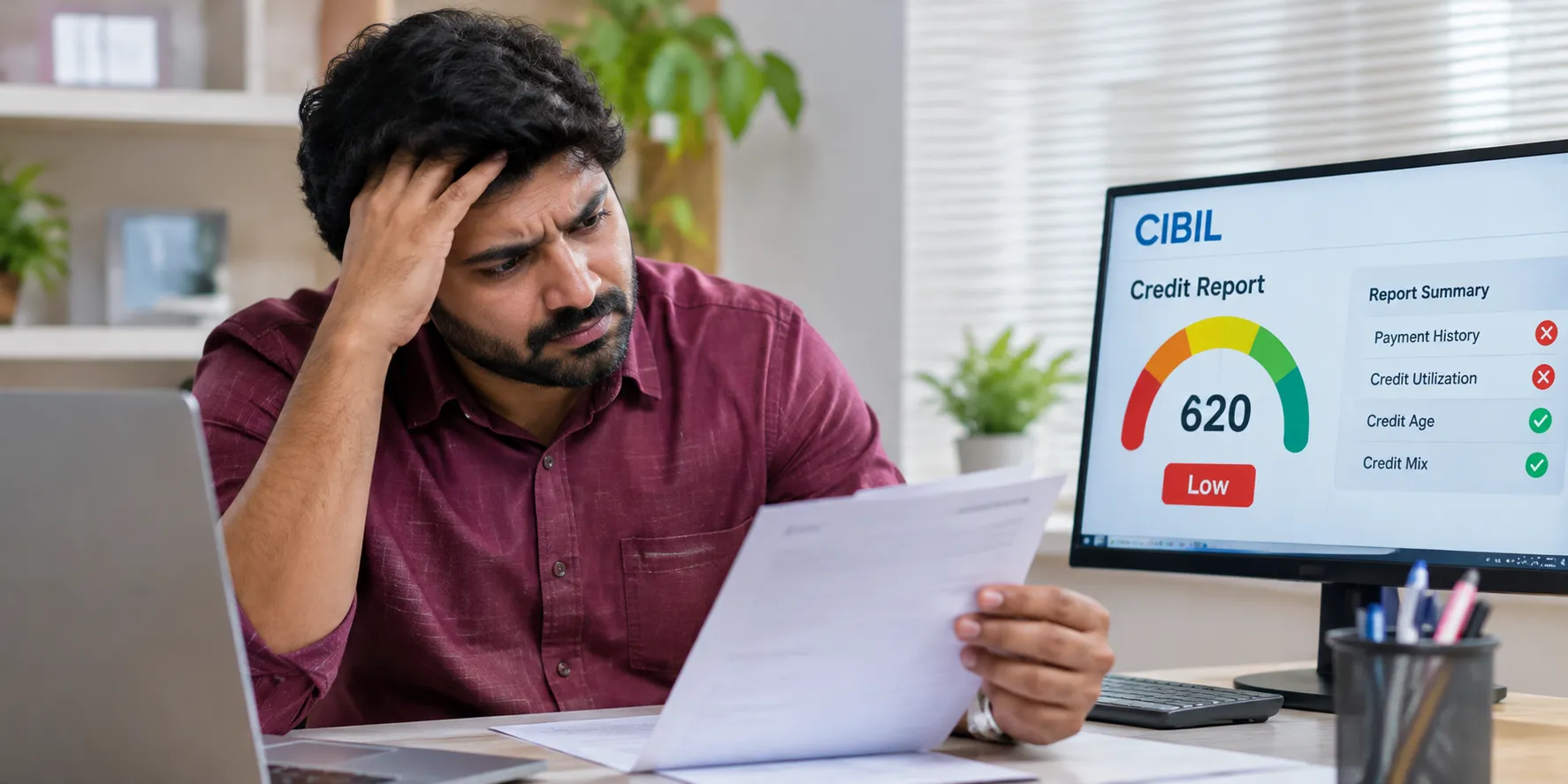
A loan you closed years ago still shows as active. A credit card you never applied for sits in your report. One EMI is marked late although your bank statement shows it was paid on time. Any of these can pull down a CIBIL score and cost you a loan, and none of them corrects itself. The way to fix them is a CIBIL dispute.
A CIBIL dispute is a request to TransUnion CIBIL, made at no cost, to correct an entry in your credit report. CIBIL does not decide the dispute on its own. It sends your request to the bank or NBFC that reported the entry and changes the report only after that lender confirms the correction. The law gives them 30 days in all, and since April 2024 every day of delay beyond that carries compensation of Rs 100.
The process matters more now than it did a few years ago. Complaints to the RBI Ombudsman against credit bureaus rose from 3,847 in 2023-24 to 4,585 in 2024-25. Since 1 July 2026 lenders report to the bureaus four times a month, so errors and corrections both reach your report faster. And by an order dated 31 August 2026, the Reserve Bank of India penalised TransUnion CIBIL Rs 26,82,800 for failing to credit this compensation to eligible complainants on time.
This guide explains how to raise a dispute in CIBIL online step by step, the control number, mail ID and other details people look for, how to check the dispute status, the 30-day rule and the compensation, what a dispute can and cannot fix, what to do if it is rejected, and how a company raises a commercial CIBIL dispute.
A CIBIL dispute is a free request to correct a wrong entry in your CIBIL report. Log in to myCIBIL at cibil.com, open Credit Reports, go to the Dispute Center and click 'Dispute an Item'. CIBIL checks with the lender. The dispute must be resolved within 30 days, or you are owed Rs 100 for each day of delay.
What is a CIBIL dispute?
A CIBIL dispute is the formal way to tell TransUnion CIBIL that something in your credit report is wrong and to ask for it to be corrected. TransUnion CIBIL is one of the four credit information companies licensed in India, along with Experian, Equifax and CRIF High Mark. Each of them builds your report from the data that banks, NBFCs and card issuers send in.
That last point decides how a dispute works. CIBIL does not create the entries in your report, and it cannot correct them on its own. Under Section 21(3) of the Credit Information Companies (Regulation) Act, 2005, a bureau can change an entry only after the lender that reported it certifies the correction. CIBIL's FAQ says the same thing: it cannot modify any information without confirmation from the lender concerned.
So every dispute has three parties: you, CIBIL and the lender. CIBIL records the dispute, forwards it to the lender and updates the report when the lender replies. This is why the strongest disputes are backed by a document from the lender itself, such as a loan closure letter or a no-dues certificate.
You also cannot dispute the score as a number. CIBIL's grievance policy and the RBI's compensation rules both leave out disputes about how the score is computed. What you dispute is the data behind the score. When the data is corrected, the score is worked out again on the corrected data.
| Section of the report | Typical errors | How it is disputed |
|---|---|---|
| Personal information | Wrong name, date of birth, gender, PAN or other identity number | Field-level dispute: you enter the correct value |
| Contact information | Old or wrong address, phone number or email ID | Field-level dispute |
| Employment information | Wrong occupation or income details | Field-level dispute |
| Account information | Closed loan shown as open, wrong balance or overdue amount, a payment wrongly marked late, the same loan listed twice, a loan or card that is not yours | Field-level dispute for wrong data, duplicate dispute for a repeated entry, ownership dispute if the account is not yours |
| Enquiry information | An enquiry from a lender you never applied to, or the same enquiry listed twice | Ownership dispute or duplicate dispute |
How to raise a dispute in CIBIL online: step by step
The steps below follow CIBIL's own instructions for individual consumers. Keep your documents ready before you start.
- Get a recent CIBIL report. Under an RBI direction in force since 1 January 2017, every bureau must give you one full credit report with your score at no cost each calendar year. CIBIL asks that the report you dispute is not older than 60 days.
- Mark every error and collect proof. Read the personal, contact, account and enquiry sections line by line. For each error, keep a document that shows the correct position. The proof table later in this guide lists what to use.
- Log in to the CIBIL dispute portal. Disputes are raised and tracked in myCIBIL. Sign in to your myCIBIL account from cibil.com. If you have never registered, create an account first.
- Open the Dispute Center. Go to Credit Reports, open the Dispute Center and click 'Dispute an Item'.
- Select the section and the entry. Choose the personal, contact, employment, account or enquiry section and pick the entry that is wrong.
- Choose the type of dispute. For a loan, card or enquiry that is not yours, choose the ownership option. For wrong data, enter the correct value against the field, such as the right closing date or the right amount overdue. For a repeated entry, mark it as a duplicate.
- Check your contact and bank details. Under the RBI's rules, compensation for delay is credited to the bank account you give when you register the dispute, and a wrong account number is treated as your mistake. Give a working email ID and mobile number as well.
- Submit and save the dispute ID. CIBIL emails a dispute summary with the dispute ID. Keep it, along with the date on which you filed.
You can cover several errors at once. CIBIL's FAQ says a single dispute can include multiple fields across sections. For any one account or enquiry, though, you choose either an ownership dispute or a dispute on its fields, not both.
Write to the lender on the same day as well. The lender has to confirm the change in any case and holds 21 of the 30 days. A written complaint to its grievance redressal officer, with the same proof, puts the request in front of the people who can act on it.
CIBIL dispute form and the control number
There are two ways into the same process. With a myCIBIL login, you raise the dispute from the Dispute Center as described above. If you only have a CIBIL report, for example one a lender pulled when you applied for a loan, CIBIL's website also has an online Dispute Form on its consumer dispute resolution page.
That form asks for a control number. The control number, also called the Enquiry Control Number or ECN, is a nine-digit number printed at the top of a CIBIL report. A new number is generated with every report, so it identifies the exact report you are disputing.
If a lender pulled the report, ask the lender for the ECN or for a copy of the report. When a lender refuses credit on the basis of a credit report, Regulation 10 of the Credit Information Companies Regulations, 2006 requires it to tell you in writing within 30 days, with the specific reasons and a copy of the report it relied on. If you have no report at all, download your own from myCIBIL and use its control number.
CIBIL dispute mail ID, phone number and address
The online route is the quickest because it creates a dispute ID at once. CIBIL also lists other official channels.
| Channel | Official detail | Use it for |
|---|---|---|
| Online | myCIBIL Dispute Center, or the Dispute Form on cibil.com | Raising and tracking a dispute |
| CIBILinfo@transunion.com | Queries and complaints. CIBIL's dispute guide also lists it as a way to raise a dispute | |
| Phone | +91 22 6140 4300, Monday to Saturday, 10 am to 6 pm | Help with a dispute or its status |
| Post or walk-in | TransUnion CIBIL Limited, One World Centre, Tower 2A, 19th Floor, Senapati Bapat Marg, Elphinstone Road, Mumbai 400 013 | Written disputes and escalations |
| Status emails from CIBIL | noreply-cibil@support.transunion.com and info@cibildisputesalert.transunion.com | Updates only. These are the sender addresses CIBIL names on its website |
CIBIL does not charge for a dispute. Treat any call, email or message that asks for a fee to raise or speed up a dispute as a fraud attempt, and check that a status email has come from one of the sender addresses above.
How to check CIBIL dispute status
Log in to myCIBIL and open the Dispute Center to see the status of each dispute you have raised. You do not have to keep checking. CIBIL's FAQ says it sends an automated status email every seven days and a further email when the lender responds.
| What you see | What it means | What to do |
|---|---|---|
| 'Under Dispute' against a field or section of the report | The dispute is open and is with the lender for verification | Wait, and follow up with the lender in writing |
| Email saying the lender has agreed to the change | The report is being corrected | Look for the updated report, which CIBIL says it sends to your email ID within five working days |
| Email saying the dispute is closed without a change | The lender has stood by the data it reported | Ask for the reasons and take your proof to the lender |
| No result after 30 days | The legal time limit has passed | Ask for compensation and escalate |
Keep three things for any follow-up: the dispute ID, the date you filed and the control number of the report. For a company dispute, the reference is the service request number in the subject line of CIBIL's status email.
CIBIL dispute resolution time: the 30-day rule and Rs 100 a day
CIBIL says a dispute takes about 30 days, depending on how quickly the lender responds. Behind that figure is a legal limit. Section 21(3) of the Credit Information Companies (Regulation) Act, 2005 requires a bureau or lender to act on a correction request within 30 days.
The Reserve Bank of India has added a price for missing it. Under its framework for compensation for delayed updation or rectification of credit information, issued on 26 October 2023 and in force from 26 April 2024, the 30 days are split between the lender and the bureau.
| Stage | Time limit | Who is responsible |
|---|---|---|
| Dispute or complaint filed with CIBIL or the lender | Day 0 | You |
| Lender sends the corrected data to the bureau | Within 21 calendar days of being informed | Bank, NBFC or card issuer |
| Bureau resolves the dispute | Within the remaining 9 days | CIBIL |
| Overall limit | 30 calendar days from the first filing | Lender and CIBIL together |
| Delay beyond 30 days | Rs 100 for each calendar day until the dispute is resolved | Whoever caused the delay, in proportion |
| Payment of compensation | Within 5 working days of resolution, into your bank account | Lender or CIBIL |
Three details decide whether you are paid. The clock starts on the day you first file the complaint, whether with the lender or with CIBIL. Compensation is due for the delay even when the final answer is that nothing in the report needs to change. And being unhappy with the outcome does not earn compensation if the dispute was closed within 30 days.
As an illustration, a dispute filed on 1 September should be closed by 1 October. If it is closed on 10 October, the delay is nine days and the compensation is Rs 900. The framework does not cover disputes about how the score is computed, or matters already before a court or a consumer commission.
The rule is being enforced. By orders dated 31 August 2026, the RBI penalised TransUnion CIBIL Rs 26,82,800, and two other credit bureaus on the same day, for failing to credit compensation to eligible complainants within the prescribed period. If your dispute ran past 30 days and nothing was credited, ask for the compensation in writing and refer to this framework.
New RBI rules that affect a CIBIL dispute
Three changes that took effect on 1 July 2026 matter to anyone raising a dispute.
| Change | What the rule says | What it means for you |
|---|---|---|
| Faster reporting by lenders | Lenders report credit data to the bureaus four times a month, as on the 9th, 16th, 23rd and last day of the month, instead of once a fortnight | A closure, payment or correction is picked up at the next weekly reporting date |
| Rejected data must be fixed quickly | Data that a bureau rejects has to be corrected and sent again before or along with the next reporting date | Fewer corrections stay stuck because a file was rejected |
| New Ombudsman scheme | The Reserve Bank - Integrated Ombudsman Scheme, 2026 replaces the 2021 scheme and continues to cover credit bureaus | A complaint must be filed within 90 days. Compensation can go up to Rs 30 lakh for consequential loss and Rs 3 lakh for loss of time, expenses, harassment and mental anguish |
Faster reporting has a practical side. Do not dispute a payment that has simply not been reported yet. Look at the 'Date Reported' against the account in your report. CIBIL's FAQ suggests raising a dispute when that date is more than two months old and your payment still does not show.
What a CIBIL dispute can and cannot fix
A dispute corrects errors. It does not erase history that is accurate. Check which side of the line your problem falls on before you raise one.
| A dispute can fix | A dispute cannot fix |
|---|---|
| A loan or card you repaid in full that still shows as open, overdue, settled or written off | A late payment, default or settlement that actually happened |
| A payment marked late when you paid on or before the due date | A 'settled' status after a one-time settlement for less than the full dues |
| An account or enquiry that does not belong to you | An enquiry from a lender you did apply to |
| Duplicate entries for the same loan or enquiry | A low score with no error behind it |
| Wrong personal details such as name, PAN or date of birth | Entries that are correct but old |
Accurate negative entries stay because the law treats them as part of your record. Regulation 10 of the Credit Information Companies Regulations, 2006 requires bureaus and lenders to keep credit information for at least seven years. If an account shows as settled because you paid less than the full dues, the status can change only if you clear the balance and the lender reports the account as closed.
A dispute raised only to make a true entry disappear will be rejected, and an agent who promises to remove it for a fee cannot deliver. CIBIL's grievance policy does not cover requests raised by third parties or credit clinics on a consumer's behalf, and the process costs nothing, so raise the dispute yourself.
Common CIBIL report errors and the proof to attach
| Error in the report | Type of dispute | Proof to keep ready |
|---|---|---|
| Loan or card closed but shown as active or overdue | Field-level dispute on the account status and closing date | Closure letter or no-dues certificate, final account statement |
| Payment marked late, or days past due shown wrongly | Field-level dispute on the payment history | Bank statement showing the date of debit, payment receipt |
| Wrong current balance or amount overdue | Field-level dispute | Latest loan or card statement |
| Account shown as settled or written off although paid in full | Field-level dispute on the account status | No-dues certificate, proof of payment, letter from the lender |
| Same loan listed twice | Duplicate account dispute | Loan account number and sanction letter |
| Loan, card or enquiry you never applied for | Ownership dispute | Identity proof, written complaint to the lender, police or cyber crime complaint if it is fraud |
| Wrong name, PAN, date of birth or address | Field-level dispute in the personal or contact section | PAN card, passport, voter ID or other identity and address proof |
Some lenders can trace an account only with the branch where the loan was taken, so keep the branch name and the loan account number handy. If you do not have them, CIBIL's FAQ advises contacting the lender directly.
What to do if your CIBIL dispute is rejected or not resolved
A dispute is commonly rejected because the lender has confirmed its data, because no proof was given, because the wrong dispute type was chosen, or because the entry is accurate. Start by finding out which of these applies. The RBI requires lenders to give reasons when they reject a request for data correction, and to tell you the action taken on a complaint in every case.
- Go back to the lender with proof. Write to the lender's grievance redressal officer with the dispute ID and the document that shows the correct position. Ask it to send the corrected data to all four bureaus.
- Raise the dispute again. CIBIL's FAQ says you can initiate the dispute again and it will verify it with the lender once more. Do this after you have the lender's letter or other fresh proof.
- Escalate within CIBIL. Use the contact page on cibil.com to reach the nodal officer and then the principal nodal officer. Under CIBIL's grievance policy, a complaint that it rejects wholly or partly is reviewed by its Internal Ombudsman.
- Complain to the RBI Ombudsman. If the lender or CIBIL does not reply to your written complaint within 30 days, or you are not satisfied with the reply, file a complaint on the RBI's Complaint Management System at . There is no fee. It must be filed within 90 days of the reply, or of the end of the 30-day wait if there was no reply.
- Approach the consumer commission. A wrong entry that a lender refuses to correct can amount to a deficiency in service under the Consumer Protection Act, 2019. The complaint must be filed within two years of the cause of action.
The Ombudsman scheme covers all four credit bureaus, banks and the larger NBFCs. A complaint can also be sent by email to crpc@rbi.org.in or by post to the RBI's Centralised Receipt and Processing Centre in Chandigarh. The RBI's contact centre on 14448 can guide you, but a complaint cannot be filed over the phone.
Consumer commissions have ordered lenders to pay for wrong reporting. In an order reported in July 2026, the Amritsar District Consumer Disputes Redressal Commission directed a bank to correct a customer's CIBIL profile, issue a no-dues certificate and pay Rs 12,500 after a fully paid credit card was shown as written off or settled. The commission also noted that CIBIL cannot change a record without the bank's confirmation. In an older Mumbai case reported in February 2022, a consumer commission awarded Rs 5 lakh against a bank that had wrongly shown a customer as a defaulter.
High Courts have not always agreed on going to court directly. On 9 August 2024, a Division Bench of the Kerala High Court, in The Director, TransUnion CIBIL Limited v. Sajeed V.M., said that a borrower's reputation is part of the right to dignity and privacy under Article 21, and that a failure to update a credit rating affects it. In V. Ramalingam v. Reserve Bank of India (2024), the Madras High Court declined to entertain a writ petition over an unrecorded loan closure, pointing to the remedy already available under Section 21(3). The practical lesson is to use the 30-day route and the Ombudsman first.
A loan or enquiry you never took: fraud and mistaken identity
Before you treat an unfamiliar entry as fraud, check one thing. CIBIL notes that a loan taken through a digital lending app can appear under the name of the partner bank or NBFC that funded it, which may be a name you do not recognise.
If the account or enquiry is still not yours, raise an ownership dispute with CIBIL and write to the lender asking for the application and KYC documents that were used. If someone has borrowed in your name, report it on the National Cyber Crime Reporting Portal at or on the 1930 helpline, and file a police complaint. Keep the acknowledgement, because it supports both the dispute and any later claim.
Two RBI safeguards help you catch this early. Since April 2024, bureaus must send an SMS or email alert when a lender accesses your credit report, and lenders must alert you when they report a default or overdue status. Both depend on your mobile number and email ID being on record, so keep them updated with every lender.
Commercial CIBIL dispute: for companies and firms
A business has its own report, the Company Credit Information Report. A dispute can be raised on a report the business bought from CIBIL or on one pulled by a lender.
- What can be disputed: company or account details, ownership of an account that does not belong to the company, and duplicate accounts.
- How to raise it: through the online company dispute form on cibil.com, or by writing to CIBIL's Mumbai office.
- Cost and time: CIBIL does not charge for it and says resolution may take up to 30 days from submission, depending on the reporting lender.
- Tracking: status updates come by email with a service request number, which you quote in every follow-up.
The RBI's Rs 100 a day compensation framework applies to commercial entities as well as individuals.
Does a CIBIL dispute affect your score or a loan application?
Raising a dispute does not by itself raise or lower your score. The score moves only if the data changes. If a wrongly reported default is removed, the improvement can be large. If the lender confirms its data, nothing changes.
You can apply for a loan while a dispute is open, but the lender will decide on the report as it stands, with the disputed entry tagged 'Under Dispute'. If the error is material, give the lender your dispute ID and proof, or wait for the correction. An accurate report matters because lenders are entitled to rely on it. In July 2026 the Kerala High Court declined to direct banks to ignore a co-borrower parent's poor credit score while deciding education loans.
Remember the other three bureaus. Since 2015 the RBI has required every lender to be a member of all the credit information companies and to report to each of them. An error that starts with the lender is therefore likely to sit in your Experian, Equifax and CRIF High Mark reports as well. Ask the lender to send the correction to all four, and check each report using the annual report you are entitled to.
Key points to remember
- A CIBIL dispute is free and is raised online from the myCIBIL Dispute Center.
- CIBIL cannot change an entry until the lender confirms the correction, so write to the lender as well.
- The dispute must be resolved within 30 days. After that you are owed Rs 100 for each day of delay, paid into your bank account.
- A dispute corrects errors. It does not remove accurate late payments, settlements or old entries.
- If it is rejected, go back to the lender with proof, raise it again, and then approach the RBI Ombudsman within 90 days.
Credit reporting rules are revised often, and contact details change. Check the current position on the CIBIL and RBI websites before you rely on a date, an amount or an address. This article is general information and is not legal or financial advice for a particular case.
Frequently asked questions
Yes. CIBIL does not charge individuals or companies for raising a dispute, whether online or by post. You are also entitled to one full credit report with your score at no cost every calendar year. Anyone who asks for a fee to raise or speed up a dispute is not acting for CIBIL.
CIBIL says about 30 days, depending on how quickly the lender responds. The legal limit is also 30 calendar days from the day you first file: 21 days for the lender and the remaining nine for CIBIL. Beyond that, RBI rules entitle you to Rs 100 for each calendar day of delay.
It is the nine-digit Enquiry Control Number, or ECN, printed at the top of a CIBIL report. A new number is generated with every report, so it identifies the exact report you are disputing. If a lender pulled the report, ask the lender for it, or download your own report from myCIBIL.
CIBIL's support email is CIBILinfo@transunion.com, and its dispute guide lists it as one way to raise a dispute. The online Dispute Center is still the better route because it gives you a dispute ID straight away. Status updates come from CIBIL's own no-reply sender addresses, not from personal email IDs.
Log in to myCIBIL and open the Dispute Center. The disputed field shows as 'Under Dispute' until it is resolved. CIBIL also emails a status update every seven days and a further email when the lender responds. For a company dispute, quote the service request number given in CIBIL's email.
Only if the dispute corrects data that was pulling the score down, such as a wrongly reported default or late payment. The score is then worked out on the corrected data. A dispute that is rejected, or one that only corrects an address or phone number, usually leaves the score where it was.
Ask for the reasons, which the lender must give. Take your proof to the lender's grievance officer, then raise the dispute again so that CIBIL verifies it once more. If there is no reply in 30 days, or you are not satisfied, complain to the RBI Ombudsman within 90 days. A consumer commission is the next option.
Yes, if the status is wrong, for example when you paid in full and hold a no-dues certificate. If you did settle for less than the dues, the entry is accurate and a dispute will not remove it. The status can change only if you clear the balance and the lender reports the account as closed.
Only an enquiry you did not authorise, or one that appears twice. Raise an ownership or duplicate dispute in the enquiry section and write to the lender named in it. An enquiry made when you actually applied for a loan or card is accurate, so it stays on the report.
A CIBIL dispute corrects only the CIBIL report. Lenders report to all four bureaus, so the same error may appear in each of them. Ask the lender to send the correction to all four, check each report, and raise a dispute with any bureau where the error remains.
References
The following official resources, regulations, circulars and case reports were consulted while preparing this article. Check the linked source for the latest version or status before relying on a date, contact detail or procedure.
- TransUnion CIBIL: A Guide to CIBIL Dispute Resolution Process
- TransUnion CIBIL: Contact Us FAQs
- TransUnion CIBIL: FAQ on Loan Rejections and Disputes
- TransUnion CIBIL: Framework for Compensation
- TransUnion CIBIL: Company Dispute Resolution
- TransUnion CIBIL: Consumer Grievance Redressal Policy (PDF)
- RBI Circular RBI/2023-24/72, Framework for Compensation to Customers for Delayed Updation or Rectification of Credit Information, 26 October 2023 (PDF copy)
- RBI Circular RBI/2023-24/73, Strengthening of Customer Service Rendered by Credit Information Companies and Credit Institutions, 26 October 2023 (PDF copy)
- RBI Press Release 2026-2027/1042: Monetary Penalty on TransUnion CIBIL Limited, 4 September 2026
- RBI: Credit Information Reporting Amendment Directions, 2025, 4 December 2025
- RBI: FAQs on the Reserve Bank - Integrated Ombudsman Scheme, 2026 (PDF)
- RBI: Annual Report of the Ombudsman Scheme, 2024-25, Appendix 1.4
- RBI Circular RBI/2016-17/58: Free Annual Credit Report to Individuals, 1 September 2016
- RBI Circular RBI/2014-2015/405: Membership of Credit Information Companies, 15 January 2015
- India Code: Credit Information Companies (Regulation) Act, 2005 and Credit Information Companies Regulations, 2006
- Kerala High Court: The Director, TransUnion CIBIL Limited v. Sajeed V.M., W.A. Nos. 444, 445 and 447 of 2024, 9 August 2024
- Kerala High Court: W.P.(C) No. 40358 of 2025 and connected cases, 13 July 2026
- Taxmann: V. Ramalingam v. Reserve Bank of India, [2024] 163 taxmann.com 705 (Madras)
- Law Trend: Consumer Panel Penalises ICICI Bank for Inaccurate CIBIL Reporting, 24 July 2026
- Fintech Biz News: Three Credit Bureaus Penalised, 5 September 2026
Disclaimer
This article is for general informational purposes only. It is not legal, financial or credit-repair advice for any particular person or situation. Credit reporting rules, CIBIL procedures, contact details and RBI directions may change. Verify the current information with TransUnion CIBIL, the Reserve Bank of India or the relevant official authority before taking action. For advice about a specific dispute, speak to a qualified professional.